

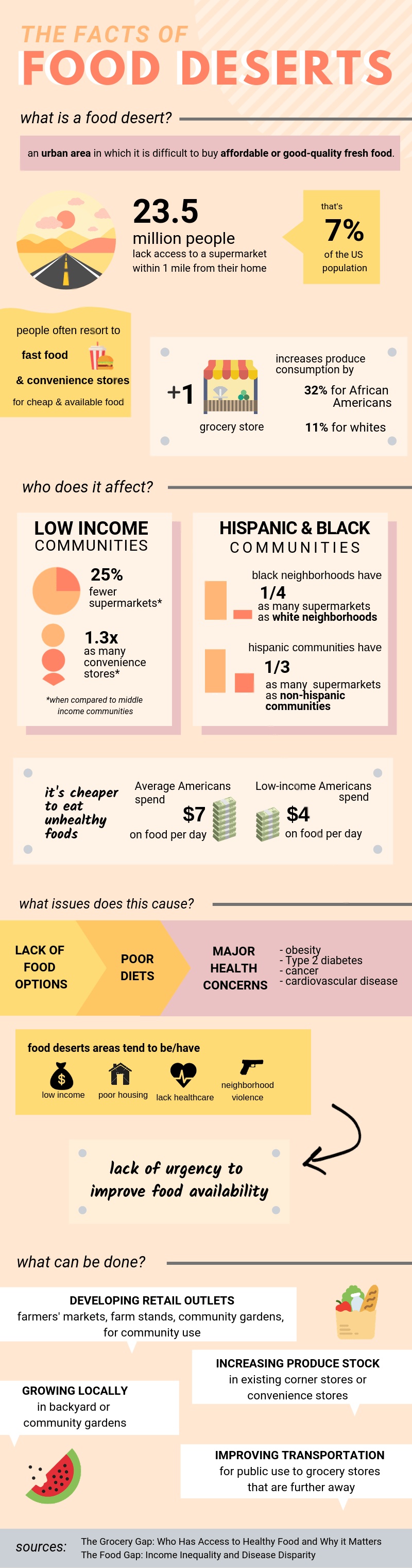
In this infographic, I am hoping to inform the reader or consumer on not only what a food desert is, but the most vulnerable groups affected by it and how they are affected. In the end, I include solutions that have been offered to solve this issue, as well as establishing that it is a political issue.
My roommate was my best resource for this assignment because she had never heard of what a food desert is at all. Because of this, I took each point and explained it to her and as I worked and tested different points, I identified the ones she found most interesting and helpful and included them. However, I also actively looked for the most concise points (or made them more concise) as well. This was a strategy I used to attempt to make the overall aesthetic more pleasing. I used data from PolicyLink called The Grocery Gap: Who Has Access to Healthy Food and Why it Matters, as well as data from Harvard Politics titled The Food Gap: Income Inequality and Disease Disparity.
In the first quarter of the infographic, I wanted to initially explain what a food desert was, and then explain how widespread and severe the issue was. I chose to use a data point on the issue of transportation because this is the statistic that is most often used to define those who live in food deserts. Additionally, this also establishes how transportation and wealth is a factor in food access. I then include data on how an additional grocery store creates a huge difference in the amount of produce — which tends to be healthier foods — increases in different racial groups, setting up the next quarter discussing the groups affected by food deserts.
Going into the ‘who does it affect’ quarter of the infographic, I highlight low-income communities, as well as African American and Hispanic communities. I used a darker orange to display the affected group and lighter orange to display the compared group. I did this because I believed the darker orange contrasted more and caught the eye better. With this data, I displayed how income affects what stores are available in comparison to a middle-income area. For racial groups, I showed a comparison of how minority groups are affected harder by food deserts. I then have a separate box to depict how those with lower incomes have much less money to spend on food, and cheaper food tends to be unhealthy.
The next quarter walks through the implications of the poor food that is eaten in food deserts — major health concerns. These are all related to poor diets, such as Type 2 diabetes, obesity, cardiovascular disease, or cancer. But because of these areas tend to be low income, consists of racial minorities, there is a large disregard to solve these issues.
The last quarter discusses what communities with food deserts can do to solve these issues. I used this as a way to establish that this is not an issue that cannot be changed and there are actually fairly straightforward ways to create change. However, these changes are largely political and require community or widespread action.
Overall, I wanted to inform the reader of what a food desert is, how widespread the issue is, and that there is hope to make a change.


